August 1, 2012

TomoTherapy Completes Acquisition of Linear Accelerator Manufacturer in China

MADISON, Wis. - Nov. 4, 2008 - TomoTherapy Incorporated (NASDAQ: TOMO), maker of the Hi·Art® treatment system for advanced radiation therapy, announced today that it has finalized the agreement to acquire privately held linear accelerator manufacturer Chengdu Twin Peak Accelerator Technology Inc., based in Chengdu, China.

A linear accelerator (linac) is a key component in radiation therapy systems used to create high-energy x-rays for cancer treatments. The linear accelerators designed, developed and manufactured by Twin Peak will be used to supplement TomoTherapy's existing supply source.

According to Steve Books, chief operating officer of TomoTherapy, 'With the acquisition of Twin Peak, we are reducing our sole supplier risk associated with our linac supply, a critical component to the Hi·Art treatment system. This acquisition will also expand TomoTherapy's competency in design and manufacturing of linear accelerators which is expected to improve Hi·Art system reliability and positively impact margins.'

Chengdu Twin Peak Accelerator Technology Inc. designs and manufactures linear accelerators for medical equipment. It is located in the provincial capital of Sichuan, China.
©

June 14, 2012

FDA clears Mevion's small-footprint proton therapy device

by Brendon Nafziger


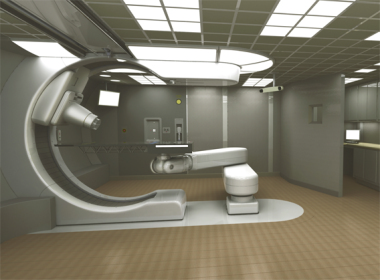
Artist rendering of a Mevion treatment room (Credit: Mevion)

It's been a long road for eight-year-old proton therapy start-up Mevion Medical Systems, formerly called Still River Systems. But the hard work appears to be paying off: the company has just earned U.S. marketing rights for a technology it claims could make the high-tech, and generally very capital-intensive, cancer-blasting technology more accessible to providers.

On Monday, the Littleton, Mass.-based company announced it received Food and Drug Administration 510 (k) clearance for its smaller-footprint proton therapy system, the Mevion S250.

Originally called the Monarch S250, the system comprises a superconducting synchrocyclotron that fires protons at energies up to 250 MeV to blast cancers. Unlike rival proton accelerators, the Mevion unit features a more compact design that's expected to lower the cost of setting up treatment centers for hospitals and radiation oncology groups, according to the company.

For instance, a center using the Mevion device likely being built next year by South Florida Radiation Oncology LLC, a Palm Beach, Fla. radiation oncology chain, is expected to cost $25 million to $35 million, whereas typical proton therapy centers can cost upwards of $120 million.

The high price-tag is one reason only 10 proton therapy centers are currently operating in the U.S. The newest center, a $160 million four-room facility made by for-profit proton chain ProCure, just opened in New Jersey this spring. However, other lower-cost proton technologies are also coming online. A McLaren Health Care center in Michigan that's scheduled to open later this year uses a ProTom International synchrotron, reported to have cost $50 million to build.

"FDA approval is a huge step forward for Mevion and for other lower cost compact machines on the horizon," Leonard Arzt, executive director of the National Association for Proton Therapy, an industry group, told DOTmed News by e-mail. "[It's] especially good news for patients. It provides added accessibility for cancer patients seeking the benefits of proton therapy. It certainly has all the makings of transforming the future of proton therapy."

First patients possibly treated this fall
Now that the device is cleared by the FDA, Mevion system users can begin treating patients as soon as their units are installed. This means the first patient could be treated this fall, according to a spokesman from Barnes-Jewish Hospital in St. Louis, where the first installation of a Mevion S250 unit began in October.

The hospital spokesman told DOTmed News in an e-mail that the one-room, $20 million Kling Center for Proton Therapy will start treating patients by the fourth quarter, and possibly as early as November 15. Once up and running, the center will treat 200 patients annually, the spokesman said.

Two other Mevion installations are also underway: one at Robert Wood Johnson University Hospital in New Brunswick, N.J. and another at Oklahoma University in Oklahoma City, Mevion said.

"Completing this very important milestone is a testament to the maturity of the Mevion organization and its ability to manufacture, install and support a safe and effective product," Mevion's CEO Joseph Jachinowski said in a statement.

Mevion, which received European marketing approval for its system in March, also has offices in London and Tokyo. The privately held company was formed in 2004, and uses technology licensed from MIT scientists.
©

April 23, 2012

GE to develop next generation compact cyclotron and PET tracer system

UPPSALA, SWEDEN AND WAUKESHA, WI, 19 April 2012 – GE Healthcare, a unit of General Electric Company (NYSE: GE), and NXT2B, a privately owned venture capital company, today announced they have entered into a joint financing agreement with the goal of developing a micro-scale radiotracer infrastructure including cyclotron and PET tracer production. The three-year development project will be led by GE Healthcare and will be headquartered in Uppsala, Sweden. The terms of the agreement were not disclosed.

“In line with GE’s healthymagination strategy to develop innovations that increase access, reduce cost and improve quality in the healthcare system globally, GE Healthcare and NXT2B are pleased to announce a joint financing project to develop an unmatched next generation of equipment and software for the production of Positron Emission Tomography (PET) tracers,” said Erik Strömqvist, general manager, Cyclotrons, GE Healthcare. “The goal of the project is to develop a turn-key radiotracer infrastructure solution for the production of PET tracers to primarily fulfill the needs of emerging markets, for rural and regional hospitals, and researchers.”

At the core of the new TRACERcenter* 600 is a unique compact, cost effective, easy to site cyclotron, and a radiotracer production operation building on GE Healthcare’s more than 80- year legacy in radiopharmaceuticals and chemistry. The PETtrace* 600 cyclotron will have approximately 50 percent smaller footprint than a traditional cyclotron, enabling siting in settings never before possible. Together with PETtrace 600, TRACERcenter 600 solution will be capable of producing a full portfolio of F18 and C11 tracers to detect cancer and neurodegenerative disease.

“We’re proud to partner with GE to help create greater access to PET tracer production in areas of the world that previously did not have access to and to address the large unmet needs for PET diagnostics in oncology and neurology,” said Bengt Ågerup ,CEO and Founder, NXT2B.

While the technology of PET scanners have rapidly developed and evolved, parallel advancements in the necessary tracer production equipment and processes have not occurred. Current PET tracer production methods are costly, complicated and require a large number of highly trained individuals. With the inherent nature of the short lived isotopes, distribution is often not possible due to lack of supporting infrastructure in regions where PET imaging is expanding.

“Simplifying the process and technology of PET tracer production involves a paradigm shift from a traditional approach to a small, easy to use cyclotron, a chemistry module that is automated, and a complete and compliant quality control process that is integrated into the system,” added Stromqvist. “GE’s cyclotrons have gained a reputation worldwide of being the most reliable, most flexible and easily upgradeable, from a company recognized as a partner by its customers.”

*Trademark of General Electric Company
ABOUT NXT2B

NXT2B is a privately owned investment company started in 2011 by the Swedish entrepreneur Bengt Ågerup. NXT2B focuses on growth equity investments in healthcare, medical devices and specialty pharmaceutical companies but also invests in technology and consumer companies. With its structure, NXT2B is able to make fast decisions on any investment opportunity and has invested in more than 30 companies. NXT2B supports its portfolio company management teams not only financially but also with entrepreneurial experience to build fast growing, market leading companies. For more information about NXT2B visit our website at www.nxt2b.com.
ABOUT GE HEALTHCARE:

GE Healthcare provides transformational medical technologies and services that are shaping a new age of patient care. Our broad expertise in medical imaging and information technologies, medical diagnostics, patient monitoring systems, drug discovery, biopharmaceutical manufacturing technologies, performance improvement and performance solutions services help our customers to deliver better care to more people around the world at a lower cost. In addition, we partner with healthcare leaders, striving to leverage the global policy change necessary to implement a successful shift to sustainable healthcare systems.
©